Selling a company is two projects running on the same calendar. One is the deal. The other is everything the deal does to your family's taxes, trusts, estate plan, and cash, and most owners give that second project a fraction of the attention it needs.
A family office runs the second project. When the Letter of Intent arrives and your M&A attorney, CPA, and estate attorney all need answers by the same Friday, the family office coordinates the personal side: taxes, trusts, estate documents, liquidity, and the conversations your family needs to have.
That role holds whether you are selling to a strategic buyer, handing the company to your children, bringing in a private equity partner, or selling a minority stake. Each path changes your operating structure along with your balance sheet. For years, the company ran payroll, filed returns, set budgets, and gave the family a shared purpose. When ownership changes, those jobs move home.
That is why owners look for family office trust and business transition services for business owners a year or more before a buyer calls. We wrote this for owners one to three years from a transition, and for the adult children who will live with the result.
TL;DR Quick Answers
Family Office Trust and Business Transition Services for Business Owners
Family office trust and business transition services give a business owner one coordinated team for the personal side of a sale, recapitalization, or family succession. That team covers trusts, taxes, estate planning, liquidity, and family decisions, and it replaces the finance and governance work the company used to handle.
Best time to start: one to three years before a transition, and before you sign a Letter of Intent, while trust, entity, and tax domicile options are still open.
During the deal: one point of contact keeps your M&A attorney, CPA, and estate attorney working from the same plan.
After closing: tax reserves, a written investment policy, funded trusts, and a regular family meeting.
Next generation: family governance, financial education, and education funding through trusts and 529 plans.
Your advisors stay: a family office works alongside your CPA and attorneys. Legal and tax advice comes from them.
Who it fits: owners whose wealth adds trusts, entities, or more than one generation. Legacy Bridge works with families managing $10 million or more.
Top Takeaways
A family office handles the personal side of a transition so the owner can stay focused on the deal or the handoff.
The months before you sign a Letter of Intent are usually the most valuable planning window.
During the transaction, the family office keeps every advisor working from one plan, which spares the owner from carrying messages between them.
The first year after closing often shapes the family's outcome more than the purchase price.
Trusts, tax planning, and investment policy work best when they are designed together with qualified counsel.
Preparing the next generation, including how their education is funded, belongs inside the transition plan.
What Is a Family Office, in Plain Terms?
A family office is a private advisory team that manages a family's investments, taxes, estate plan, and family governance from one coordinated plan. It works alongside your CPA and attorneys. It does not replace them.
Some families build their own. A single-family office has its own staff and serves one household, and Whittier Trust puts the starting cost at about $1.5 million a year. Most business owners use a multi-family office instead, which provides the same coordination through a shared team.
Why Does a Business Transition Change Everything at Once?
Because the company was doing far more than producing income.
It employed the finance team. It created tax planning opportunities through entity structure, compensation, and distributions. It gave everyone a role and a reason to sit at the same table. When ownership changes, that infrastructure stays behind with the buyer or the next generation. What comes home is cash, rollover equity, seller notes, trusts, and a long list of decisions nobody owns yet.
So the question is not, "Where should I invest the proceeds?" The better question is, "What structure needs to exist before the proceeds arrive?"
What Does a Family Office Do Before, During, and After a Transition?
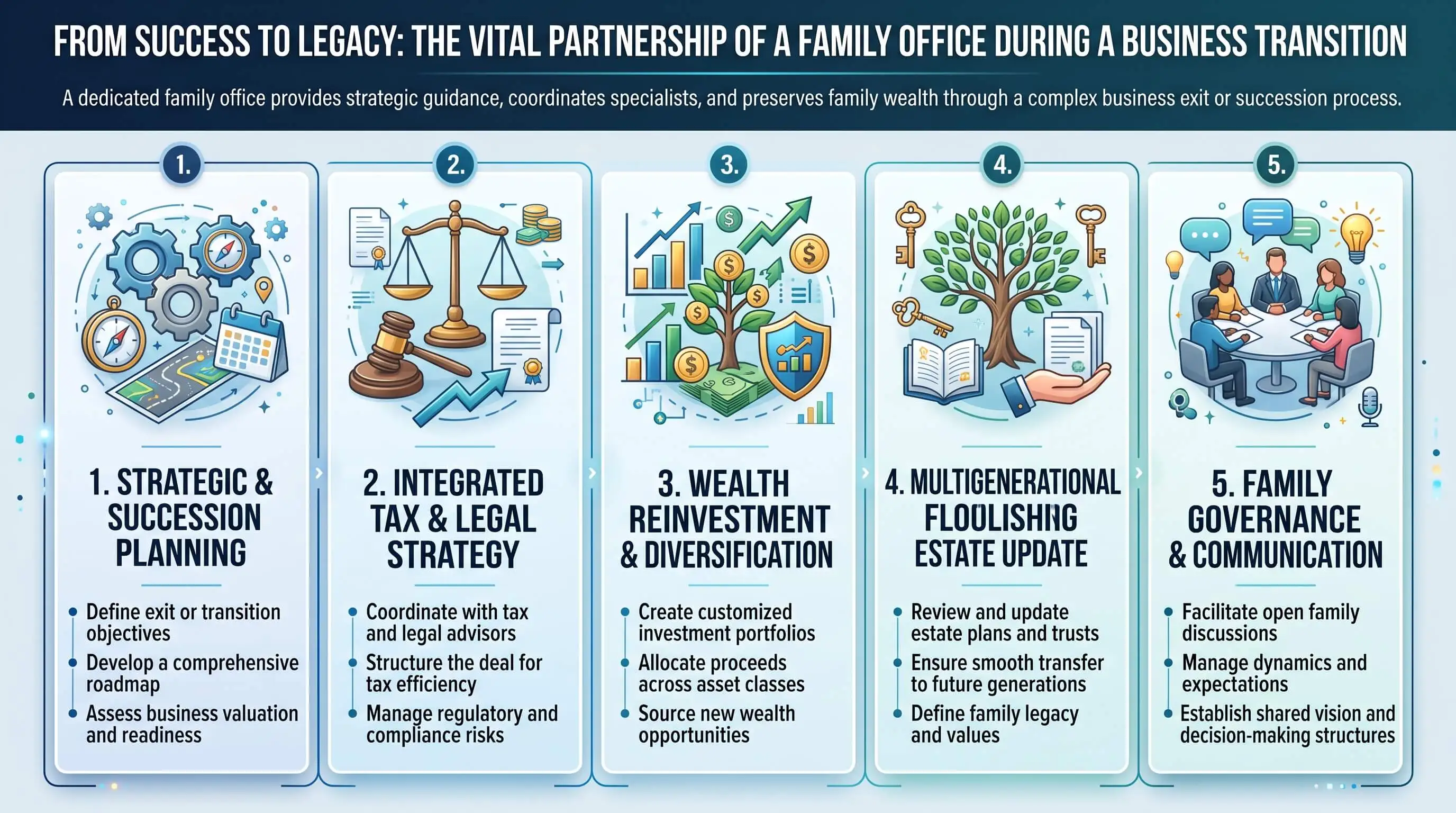
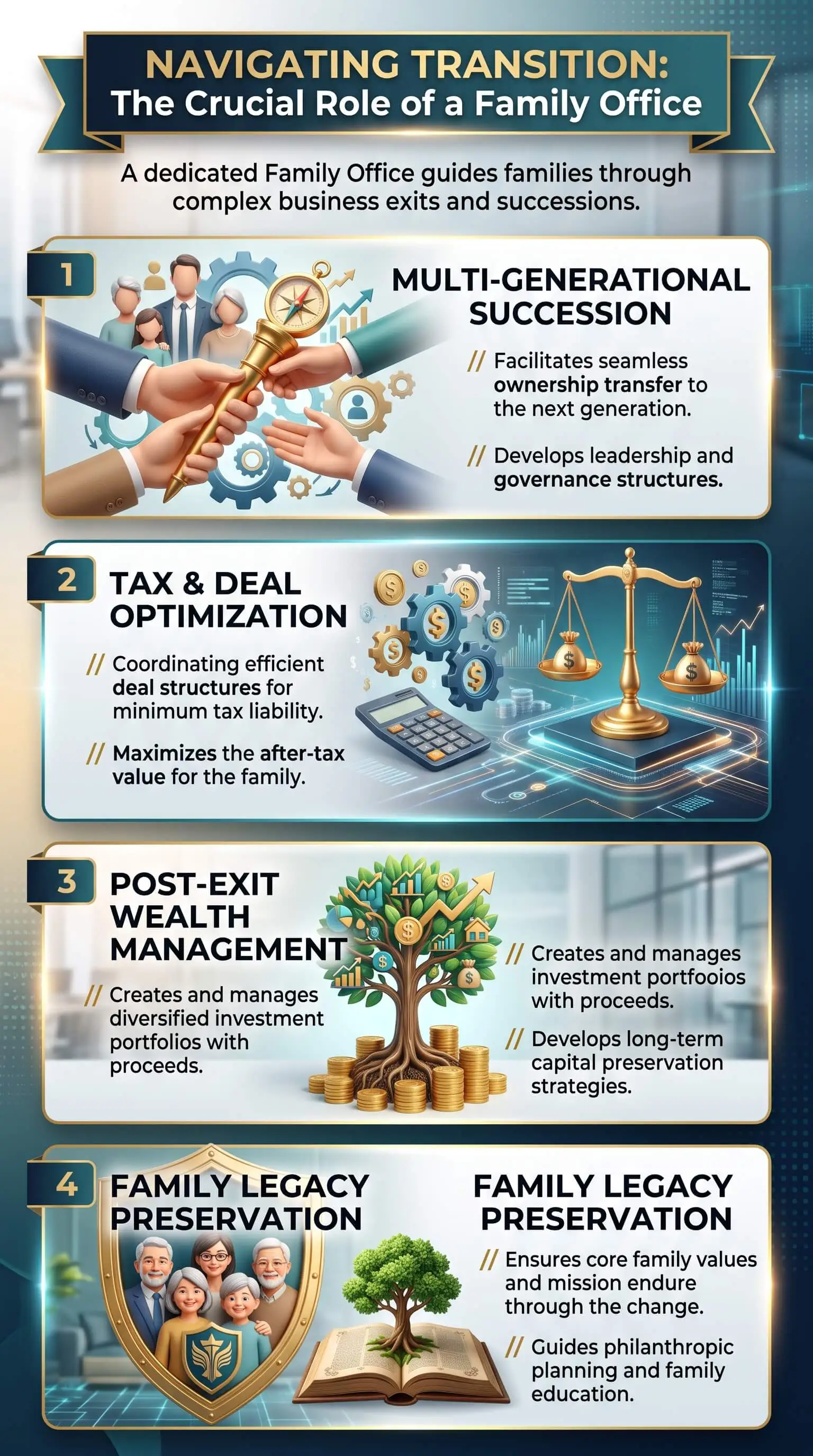
The work changes with the calendar. Before the deal, a family office shapes the plan. During it, the family office keeps every advisor working from the same numbers. Afterward, it builds the system that replaces what the company used to do.
Before the sale or handoff: reviewing entity structure and ownership records, modeling federal and state tax exposure, evaluating trust strategies with counsel, settling state tax domicile early, and estimating how much cash the family will need after closing.
During the deal: serving as one point of contact across advisors, keeping estate and trust work on the deal's timeline, re-running after-tax proceeds each time the terms move, and protecting the owner's time for negotiation.
After the transition: setting tax reserves, writing an investment policy statement, funding and implementing the estate plan, reviewing insurance and spending, and starting a regular family meeting.
Before the Letter of Intent
This is the window that matters most. Once you sign an LOI, valuations get harder to discount, deadlines compress, and some trust and domicile options close.
We spend this period with your attorneys and CPA cleaning up operating agreements and cap tables, modeling tax exposure, and testing whether specific trust structures fit your facts. Buyers will find structural problems in diligence. It is better if you find them first.
During the Deal or Handoff
Your attention belongs to the transaction. A typical sale pulls in an M&A attorney, an estate attorney, a CPA, an investment banker, a valuation expert, and an insurance advisor. Each may be excellent at the job. None of them owns the whole picture.
In our experience, this is where owners end up carrying messages between professionals, usually by phone and usually after hours. Details slip. A family office acts as the quarterback for the personal side, so the tax plan, the estate documents, and the liquidity model still agree with one another when the purchase price moves late in the process.
The First 12 Months After
The year after closing is quieter than most owners expect, and harder. The calendar empties. The wire lands. Some owners move fast into private deals and real estate because speed is what built the company. Others sit in cash for a year because nothing looks as good as the business they sold.
Neither response is a plan. A family office sets tax reserves first, then puts an investment policy in writing, reviews insurance, implements the estate plan, and helps the family decide how much risk it actually needs to take.
What Role Do Trusts Play in a Business Transition?
Trusts come up in almost every transition we see, usually for one of two reasons: moving future growth out of a taxable estate, or protecting heirs from receiving too much, too soon. Charitable goals are a frequent third.
If the company's value is likely to rise or become liquid, estate attorneys may evaluate grantor trusts, spousal lifetime access trusts, or charitable vehicles before you sign the deal. Depending on the facts, some of these work far better before an LOI than after one.
The family office does not draft these documents. Its job is to make sure the trust strategy, the tax model, and the investment plan agree, and that someone actually funds and administers the trusts once the deal closes. We find signed but unfunded trusts more often than owners would guess. Make every one of these decisions with qualified tax and legal counsel.
How Does a Family Office Prepare the Next Generation, Including Their Education?
Most owners never had to explain the wealth to their children, because the business explained itself. After a transition, it no longer does.
Sudden liquidity changes family dynamics fast. A teenager may not know where the money came from, and an adult child may assume a role nobody offered. Spouses often carry a very different tolerance for risk than the founder does. The family office gives those conversations a structure so they happen on purpose rather than by accident.
That work usually includes:
Family governance: decision rights, a regular family meeting, and a written statement of what the wealth is for.
Financial education: age-appropriate lessons on budgeting, investing, and responsibility.
Education funding: coordinating trusts, 529 plans, and cash flow for tuition, from private school education through graduate school.
Gradual responsibility: observer seats on the family investment committee before full roles.
For families where schooling is a priority, we model tuition for every child across every year it applies. That puts education inside the long-term plan instead of beside it, where it tends to get funded from whatever account is closest.
Family Office vs Wealth Manager vs CPA: Who Does What?
A wealth manager runs the portfolio. A CPA handles tax filings and compliance. A family office coordinates both, then adds the estate, trust, and family work neither was hired to do.
Wealth manager: manages investments, with limited alignment between tax strategy and the portfolio, and rarely oversees trusts, entities, or family governance.
CPA: prepares and files returns and may handle part of the trust and entity work, but does not manage investments or lead the wider advisory team.
Family office: manages or oversees the portfolio, works with the CPA on tax strategy, oversees trusts and entities, supports family governance and heirs, and keeps every advisor on one plan.
For a simple, fully liquid situation, a traditional wealth manager may be enough. Once a transition adds trusts, entities, and more than one generation, family-office-level coordination is usually the better fit.
"The call we wish came earlier is the one that starts with, 'We just signed the LOI.' By then, some of the best trust and domicile options have narrowed, and the owner is already stretched thin by diligence. The other pattern we see is treating closing day as the finish line. The first year after a sale usually does more to shape a family's long-term outcome than the purchase price. Cash sits without a plan. Requests start coming in from people the owner has not heard from in years. The kids are quietly wondering what all of this means for them. Our job in that year was simple to describe and hard to do: set the tax reserves aside, get an investment policy on paper, and sit the family down to talk about what the wealth is for."
7 Essential Resources
- A neutral starting point on what family offices are and how single-family and multi-family models differ.
- Makes the case that running a family office after a sale is closer to starting a second business than taking a victory lap. Worth reading before closing.
- Includes the story of a family that set up a family council and investment committee before selling a manufacturing company it had owned for nearly 70 years.
- Useful for the cost side, including what it takes to run a single-family office and why many families choose a multi-family office.
- National data on owner age and what employer-business owners plan to do with their companies before they retire.
- A 491-owner survey on succession planning gaps and how ready owners believe the next generation is.
- Our own guide to the pre-sale window, the first 12 months after a liquidity event, and how a family office replaces the finance and governance work the company used to handle.
If you only have time for two, start with IESE and RSM. Both are written for families who have already sold or are about to and are considering virtual outsourced finance and accounting services as part of the transition.
3 Statistics
52.3% of U.S. employer businesses are owned by people 55 or older. That is roughly 3 million companies, based on Gallup's March 2025 analysis of U.S. Census Bureau data. Gallup also found that 74% of employer-business owners plan to sell or transfer ownership. A large wave of transitions is already underway.
Only 46% of private business owners have a formal succession plan in progress, and 30% have none. In the same Brown Brothers Harriman survey from October 2025, 40% of owners said the next generation is unprepared to manage wealth.
Just 27% of family offices have a structured process to prepare heirs for future roles. The UBS Global Family Office Report 2026 surveyed 307 family offices and found only 35% had a succession plan for the family office itself, as reported by IESE Business School.
Read together, these numbers say the same thing we see in practice. Families plan the transfer of money carefully and leave the people who will inherit it to figure things out later.
Final Thoughts and Opinion
Our view is simple. Talk to a family office before anyone asks to buy your business.
Owners wait for understandable reasons. The company is busy. The sale still feels hypothetical. And planning for life after the business can feel a little like admitting it is over. Yet the owners who come through a transition with the most options are almost always the ones who built the personal structure first, while trusts, domicile, and entity decisions were still open.
We would also push back on the idea that a transition ends at closing. It ends when the family understands the plan. The spouse knows the investment policy, and the adult children know what the trusts are for. Even the youngest understand that their education is part of something the family decided on together.
That is what family office trust and business transition services for business owners should deliver. A better portfolio on day one matters less than a family that still agrees on the plan in year ten.
Frequently Asked Questions
What does a family office do during a business sale?
A family office coordinates the personal planning around the sale. It keeps your CPA, estate attorney, and investment advisors working from the same numbers, re-runs after-tax proceeds as terms change, and keeps trust and estate work on the deal's timeline. That leaves the owner free to negotiate and close.
When should a business owner bring in a family office?
Ideally one to three years before a sale or succession, and before you sign a Letter of Intent. That early window may keep trust, entity, and state tax domicile options open that become harder to use once a transaction is moving.
Is a family office different from a wealth manager?
Yes. A wealth manager usually focuses on the investment portfolio. A family office manages the wider financial life of the family, including taxes, trusts, estate planning, entities, insurance, advisor coordination, and family governance. Investments are one piece of that system.
Can a family office help pass a business to my children?
Yes. A family office works with your attorneys to design the ownership transfer, lines up trusts and buy-sell agreements with your intent, and prepares your children through family meetings, financial education, and a gradual increase in responsibility before they step into ownership or leadership.
Can a family office help plan for my children's or grandchildren's education?
Yes. We model tuition for each child over every year it applies and coordinate trusts, 529 plans, and cash flow to pay for it. That can cover independent school tuition, college, and graduate study, all planned inside the family's long-term strategy.
How much wealth do you need to use a family office?
Complexity matters more than a fixed number. Legacy Bridge works with families managing $10 million or more, and many business owners first consider family-office-level support around a sale or other liquidity event. For a simple, fully liquid situation, a traditional wealth manager may be all you need.
Build the Structure Before the Transition Begins
If a sale, recapitalization, or family succession is on the horizon, the planning window is probably shorter than it looks. Legacy Bridge works with business owners and their families to coordinate the tax, trust, estate, and family decisions that come before and after a major business change through outsourced family office executive services. Schedule a private consultation, and we will start by mapping where your family stands today.