Your estate plan can be legally sound and still fail your family. Documents record your intent, but they only control the accounts, titles, and beneficiary forms that actually line up behind them. An estate planning coordination checklist closes that gap. It confirms your trusts are funded, your property is titled the way the plan assumes, and every beneficiary form says what you meant it to say, and it keeps your attorney, CPA, and advisors working from one inventory as your life changes.
Most families treat the signing meeting as the finish line, and that is usually where the work stops. Within a year or two, the plan starts to drift. You open a new brokerage account in your own name, or the cabin you bought in Wisconsin last spring never goes into the trust. Nothing looks wrong until someone needs the plan to work.
We spend most of our time in that gap between paper and practice. It's why families with trusts, business interests, or property in more than one state look for estate planning coordination that keeps trust funding, titling, and beneficiaries aligned long after the attorney's engagement ends.
This checklist is for parents and business owners who already have an estate plan, or are close to signing one, and want it to hold up. If your children attend a private or independent school, item 10 was written with you in mind.
TL;DR Quick Answers
Estate Planning Coordination
Estate planning coordination puts a signed estate plan into effect across your real accounts, titles, and beneficiary designations, and keeps your attorney, CPA, and advisors aligned as your life changes.
What the checklist covers: asset inventory, document copies, an advisor roster, tax alignment, business agreements, trust funding, titling, beneficiaries, provisions for minor children, incapacity documents, and a review calendar.
The most common gap: trusts that were signed but never fully funded.
Who handles it: a coordinator or family office working alongside your attorney and CPA, who still provide the legal and tax advice.
How often to review: every year, and after any major life, business, or tax law change.
For parents: name guardians with backups, plan for education costs, and name a successor owner on every 529 plan.
2026 tax context: the federal basic exclusion amount is $15 million per person.
Top Takeaways
Estate planning coordination turns signed documents into a working plan by lining up your accounts, titles, and beneficiary forms with what the documents say.
The gaps we see most are trusts that were never fully funded, outdated beneficiary forms, and out-of-state property left outside the trust.
Your attorney and CPA stay in place. A coordinator keeps them on one inventory and follows each task through to completion.
Parents should name guardians with backups, plan how education gets paid for, and name a successor owner on every 529 plan.
Review the plan every year, and again after a major life event, a move, a business change, or a tax law change.
The 2026 federal exclusion is $15 million per person. Ask your advisors what that means for your gifting and trust planning.
What Is Estate Planning Coordination?
Estate planning decides where your assets go and who acts for you when you can't. Estate planning coordination is the follow-through that makes those decisions hold.
Drafting and implementation are separate jobs, and they usually belong to different people. Your attorney writes the will, the trusts, and the powers of attorney. Your CPA models the tax effect. Someone still has to retitle the accounts, update the beneficiary forms, record the deeds, and check back next year. When that work has no owner, it tends to stall halfway.
Coordination doesn't replace your attorney or CPA. They remain the technical experts. Our role is to keep them working from one inventory and one set of priorities, and to track each task until it's verified complete.
The Estate Planning Coordination Checklist: 12 Items to Verify
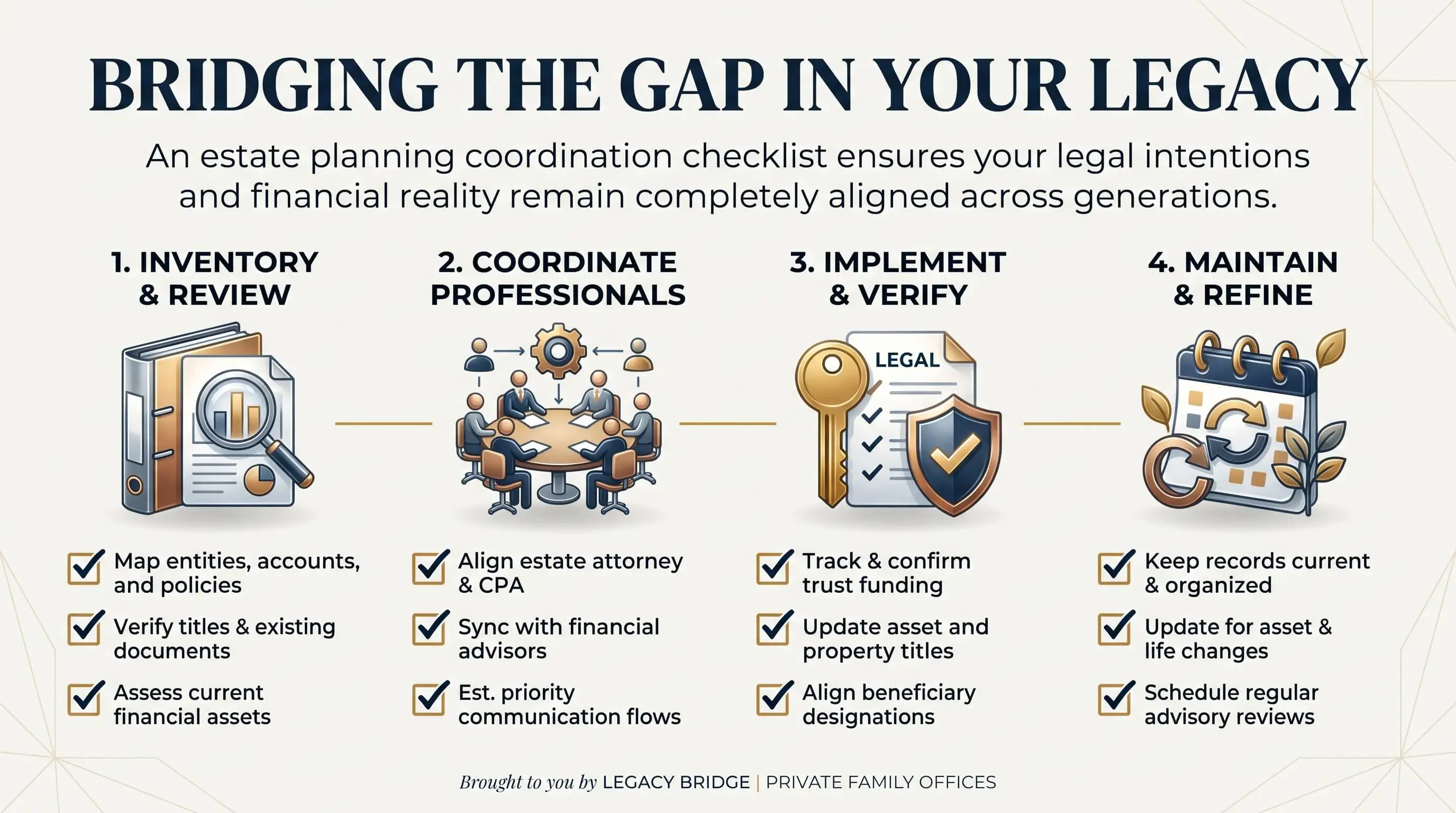
We work through the checklist in the same order we run an engagement: inventory, then alignment with your advisors, then implementation, then ongoing maintenance.
Inventory and Review
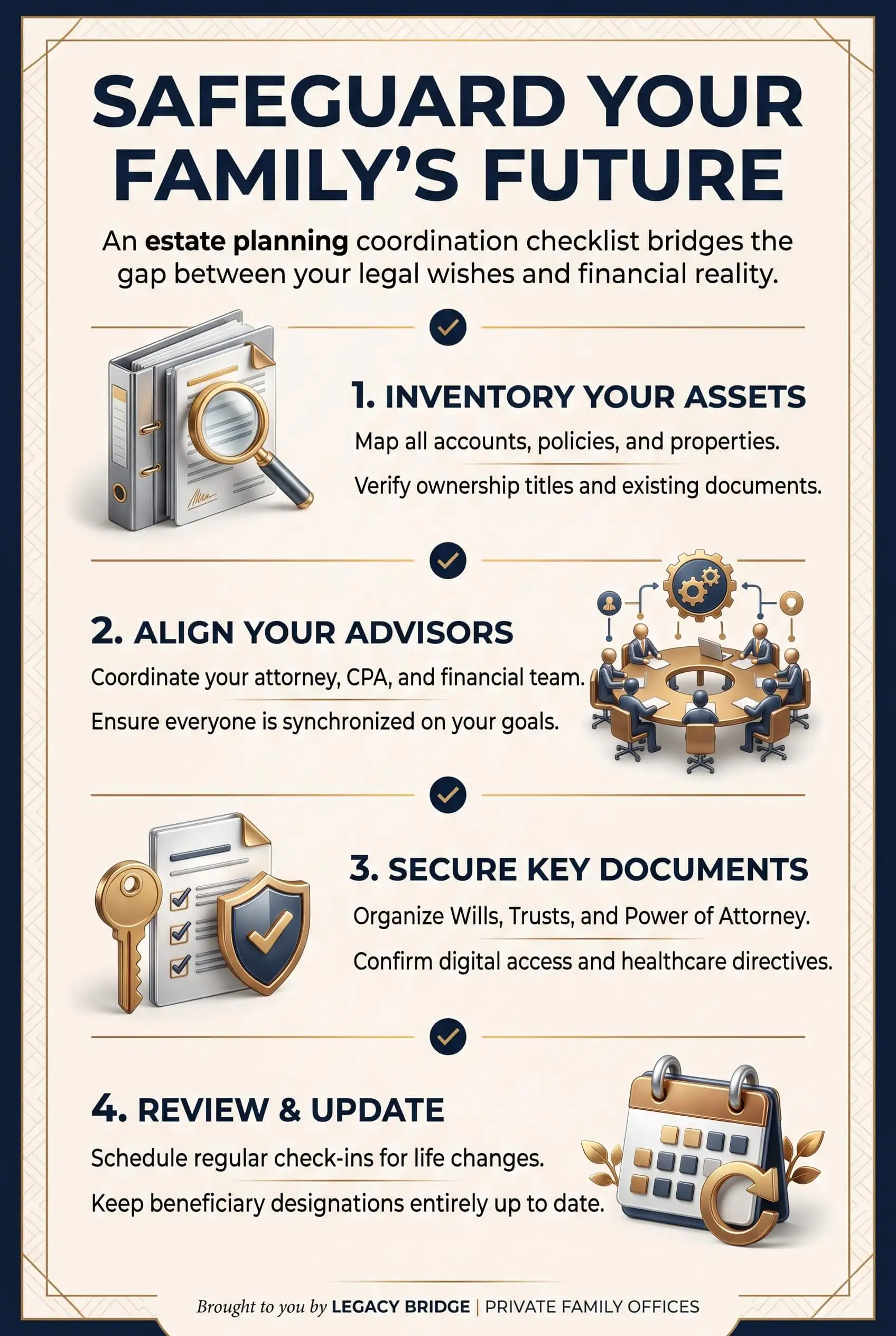
1. A complete asset and entity inventory. List every account, property, policy, business interest, trust, and LLC, along with how each is owned today. A plan can't be aligned with assets nobody has written down.
2. Current copies of every document. Gather the will, trusts, amendments, powers of attorney, and health care directives. Note who holds each original and when it was last updated.
3. An advisory team roster. Write down your attorney, CPA, wealth advisor, insurance advisor, and trustee, with contact details and what each one handles. Your executor and successor trustee should know where to find it.
Coordinate the Professionals
4. One shared priority list. Agree on what happens first and who does it. In our experience, separate to-do lists kept by three different offices are where tasks quietly disappear.
5. Tax alignment. For 2026, the federal basic exclusion amount is $15 million per person. Ask your CPA and attorney how that affects your gifting, the portability election for a surviving spouse, and any generation-skipping transfer planning. Several states set their own estate tax at far lower levels, so check yours.
6. Business interests and buy-sell agreements. Operating agreements, buy-sell terms, and key-person insurance should all match the estate plan. This matters most ahead of a sale or succession, which is why a family office's role during a business transition starts with the estate documents.
Implement and Verify
7. Trust funding, account by account. A trust controls only the assets titled in its name. Check each brokerage, bank, and investment account the plan says belongs in the trust. Signed but unfunded trusts are the gap we find more often than any other.
8. Titling and deeds. Review real estate deeds first, especially out-of-state property. A vacation home left outside the trust can send your family through probate in a second state. Then check vehicles and closely held shares.
9. Beneficiary designations. Retirement accounts, life insurance, annuities, and transfer-on-death accounts pass by beneficiary form, not by your will. Confirm both the primary and contingent beneficiary on each one.
10. Provisions for minor children. Name guardians and a backup for each. Spell out how education will be paid for, from private school tuition through college, and name a successor owner on every 529 plan. Parents skip that last step more often than they expect.
Maintain and Refine
11. Incapacity documents, digital assets, and letters of wishes. Make sure your financial and health care powers of attorney are current and that your bank and brokerage will accept them. Record how to access your digital accounts. A letter of wishes can settle questions about heirlooms and personal items before they become disagreements.
12. A review calendar and a family communication plan. Put the next review on the calendar today. Then decide what your heirs need to understand about the plan, and when you'll tell them.
Who Does What in Estate Planning Coordination?
Each professional owns one piece of the plan. The coordinator owns the connections between them.
Estate planning attorney: drafts the wills, trusts, and powers of attorney, gives legal advice, and confirms the documents are valid under state law. Sends the coordinator funding instructions and any required retitling.
CPA: prepares returns and tax projections and handles gift and estate tax filings and elections. Flags tax-driven timing to the coordinator.
Wealth advisor: manages the investment accounts and their registrations. Reports account changes and new accounts.
Insurance advisor: handles life, disability, and umbrella coverage, including policy ownership and beneficiaries. Reports policy changes.
Coordinator or family office: keeps the inventory and the task list, verifies each item is complete and current, and sends updates back to every advisor.
How Often Should You Review Your Estate Plan?
We recommend a review every year, plus a check whenever one of these events happens.
Marriage, divorce, or remarriage: beneficiaries, trustees, and powers of attorney.
Birth or adoption: guardians, education funding, and 529 successor owners.
A move to another state: state tax exposure, document validity, and deeds.
A business sale or new venture: buy-sell terms and where the proceeds are titled.
New real estate: whether the deed went into the trust.
Death of a family member or named fiduciary: executors, trustees, and guardians.
A change in tax law: your gifting approach and how much exemption you've used.
"When families bring us their estate plan, the documents are almost always sound. A good attorney did careful work. The trouble sits around the documents. We regularly see a revocable trust signed years ago with only a few of the family's accounts ever moved into it. Just as often, a life insurance policy still names a sibling or former spouse who should have been removed long ago. Nobody made a bad decision. The plan simply had no owner once the signing meeting ended, and that's the part we take on. We keep the attorney, the CPA, and the advisors working from one inventory, and we don't mark a task complete until we've confirmed it with the institution."
7 Essential Resources
Wikipedia: Estate planning A plain overview of the documents and goals involved. Worth a read before your first attorney meeting.
IRS: What's New, Estate and Gift Tax The official source for the current basic exclusion amount and the changes made by the One, Big, Beautiful Bill.
Caring.com: Wills and Estate Planning Survey Yearly data on who has estate documents, who doesn't, and what finally gets people to update them.
Cerulli Associates: $124 Trillion in Wealth Will Transfer Through 2048 Useful context on the size of the coming transfer, including how much passes to a surviving spouse first.
Montecito Bank and Trust: Coordinating Your Estate Plan Estate attorney Martin Shenkman on why your CPA, attorney, trust officer, and wealth advisor need to talk to each other, and what breaks when they don't.
Wiss: The Quarterback Approach to Estate and Wealth Planning Practical examples of coordination failures, such as a large year-end gift made without the estate attorney's input.
Legacy Bridge: Efficient Estate and Tax Planning Case Study How we coordinated one family's advisors and facilitated the family conversations behind a complex estate plan update.
If you only have time for two, read the Shenkman article and the IRS page. The first explains why coordination breaks down, and the second gives you the numbers your advisors are working from.
3 Statistics
Only 24% of U.S. adults reported having a will in 2025, down from 33% in 2022. Parents of children under 18 are the largest group without a will or any other estate documents, according to the Caring.com 2025 Wills Survey.
Cerulli Associates expects $124 trillion in wealth to change hands through 2048, with roughly $105 trillion going to heirs and $18 trillion to charity, per its December 2024 report.
The IRS set the 2026 basic exclusion amount at $15 million per person, up from $13.99 million in 2025.
Put those numbers side by side and the picture is uncomfortable. A huge amount of wealth is about to change hands under federal rules that just changed, while parents of young children, who have the most riding on a plan, are the least likely to have one. Signed documents are only the starting point, and what protects your family is keeping them aligned with the assets you actually own and any charitable assets overseen through family foundation management.
Final Thoughts and Opinion
An estate plan is only as reliable as its last review. We'd put that ahead of any single document or strategy.
Families put serious thought into choosing guardians and deciding what the next generation should receive. After the signing meeting, though, nobody owns the plan. The attorney's engagement wraps up. The CPA looks at the plan once a year, at tax time, and the wealth advisor sees only the accounts they manage. Each assumes someone else has the full picture.
Someone needs to. Estate planning coordination gives the plan one accountable owner and a fixed date for the next review. It isn't complicated work, but it has to belong to somebody.
We'd also push back on the idea that coordination is only for very large estates. Picture parents with two children in independent school, a home, a 401(k), and a term life policy. That family already has several places where the plan can quietly drift. A carefully chosen guardian doesn't help much if the life insurance pays out to the wrong person or the 529 plan has no successor owner.
Work through the checklist above with your advisors and family office concierge support, and set the date for your next review before you put the binder back on the shelf.
Frequently Asked Questions
What is estate planning coordination?
Estate planning coordination is the work of putting a signed estate plan into effect and keeping it current. It confirms that trusts are funded, assets are titled correctly, and beneficiary designations match your intent. It also keeps your attorney, CPA, and advisors working from one inventory as your life and holdings change.
What should an estate planning coordination checklist include?
Start with an inventory of assets and entities, current copies of your documents, and a roster of your advisors. From there, cover tax alignment, business agreements, trust funding, titling and deeds, and beneficiary designations. Finish with provisions for minor children, incapacity documents, digital assets, and a scheduled review date.
Does a family office replace my estate planning attorney?
No. Your attorney drafts the documents and gives legal advice, and your CPA handles the tax work. A family office like Legacy Bridge works alongside both of them. We drive implementation and follow-through, so the plan they designed shows up in your accounts, titles, and records year after year.
What does trust funding mean, and why does it matter?
Trust funding means retitling assets into the trust's name so the trust controls them. A trust governs only what it holds. An account or property left outside it can end up in probate or with the wrong person, no matter what the trust document says.
How should parents plan for a child's education in an estate plan?
Name a guardian and a backup, and decide who will manage the money set aside for your children. Then set out how tuition will be covered, whether that's an independent school, college, or graduate study. Trusts and 529 plans both work well here. Name a successor owner on each 529 so the account doesn't get stuck.
How often should an estate plan be reviewed?
Once a year works for most families. Review it sooner after a marriage or divorce, a birth or adoption, a move to another state, a business sale, a new property, the death of someone named in the plan, or a change in tax law.
Make Your Estate Plan Workable
If your estate plan has been sitting in a binder since the day you signed it, now is a good time to see how closely it still matches your life. Legacy Bridge works with families and business owners to inventory their assets, bring their attorney and CPA onto one plan, and verify trust funding, titling, and beneficiaries until every item is done. Your advisors stay exactly where they are, and we keep the plan moving. Schedule a private consultation, and we'll start by mapping where your plan stands today.


